Motion Graphics & Animation

Interpersonal Effectiveness Roleplay Animation for Lethbridge College

Teaching Communication Skills Through Scenario-Based Storytelling

Client Lethbridge College – Student Success & Learning Services
Role Storyboard Artist & Animator
Deliverables 2-3 minute educational animation with storyboard, character design, and full production
Audience College students (diverse academic programs, ages 18-35+)
Tools Animation software, character design, audio production
Watch Video on Vimeo →

Teaching Soft Skills Through Concrete Examples

Lethbridge College's Student Success department needed an effective way to teach interpersonal communication skills—specifically the DEARSAN communication framework technique from Dialectical Behavior Therapy (DBT)—to help students navigate challenging academic conversations with confidence and professionalism.

The Learning Gap:

Current State:

  • Students lacked concrete examples of how to approach difficult conversations with instructors
  • Many avoided addressing academic concerns due to fear of confrontation or uncertainty about appropriate communication
  • Abstract descriptions of communication frameworks (DEARSAN acronym) didn't translate to real-world application
  • Students struggled to balance assertiveness with respect in power-imbalanced situations (student-instructor dynamic)

Desired State:

  • Students understand each component of the DEARSAN framework through observable behavior
  • Students can recognize effective communication strategies in context
  • Students feel empowered to advocate for themselves professionally
  • Students can apply the framework to similar academic situations (grade discussions, extensions, accommodations)

Root Cause: Students needed to see the framework in action, not just memorized. The challenge wasn't information delivery—it was modeling professional advocacy behavior in a realistic, relatable scenario.

Audience Challenges: Diverse Student Population

Audience Profile:

  • Demographics: Ages 18-35+, diverse cultural backgrounds, varying communication confidence levels
  • Context: Students experiencing academic stress, grade concerns, time constraints
  • Attitude: Some anxiety around instructor interactions, desire for practical guidance
  • Learning Preference: Visual learners, scenario-based examples, short-form content compatible with social media consumption habits

Instructional Challenge: The animation needed to demonstrate assertive communication without appearing confrontational, show vulnerability without weakness, and model professionalism in a situation many students find intimidating—all within 2-3 minutes.

From Framework to Animation

Needs Analysis & Concept Development

1. Framework Integration

I worked with Lethbridge College stakeholders to understand the DEARSAN communication framework and how it applies to common student scenarios:

  • Describe the situation (facts, not judgments)
  • Express clearly (feelings and opinions)
  • Assert wishes (specific requests)
  • Reinforce (positive outcomes for all parties)
  • Stay mindful (focus on goals)
  • Appear confident (tone, posture, language)
  • Negotiate (find middle ground)

2. Scenario Selection

Through consultation with Student Success advisors, we identified the grade discussion scenario as highly relatable and commonly anxiety-inducing. The situation needed to demonstrate:

  • Student experiencing legitimate academic concerns (vague test questions, instructor unavailability, unanswered emails)
  • Professional tone despite frustration
  • Clear problem description without blaming
  • Specific, reasonable solution proposal
  • Positive resolution through collaborative problem-solving

3. Character & Visual Design Decisions

  • Character Design: Approachable, diverse, relatable student and instructor characters with neutral styling to maximize identification across demographics
  • Setting: Simple office environment—recognizable but not distracting from dialogue
  • Visual Style: Clean, friendly illustration style with hand-drawn warmth to reduce formality and intimidation

Storyboard Development

Strategic Scene Breakdown:

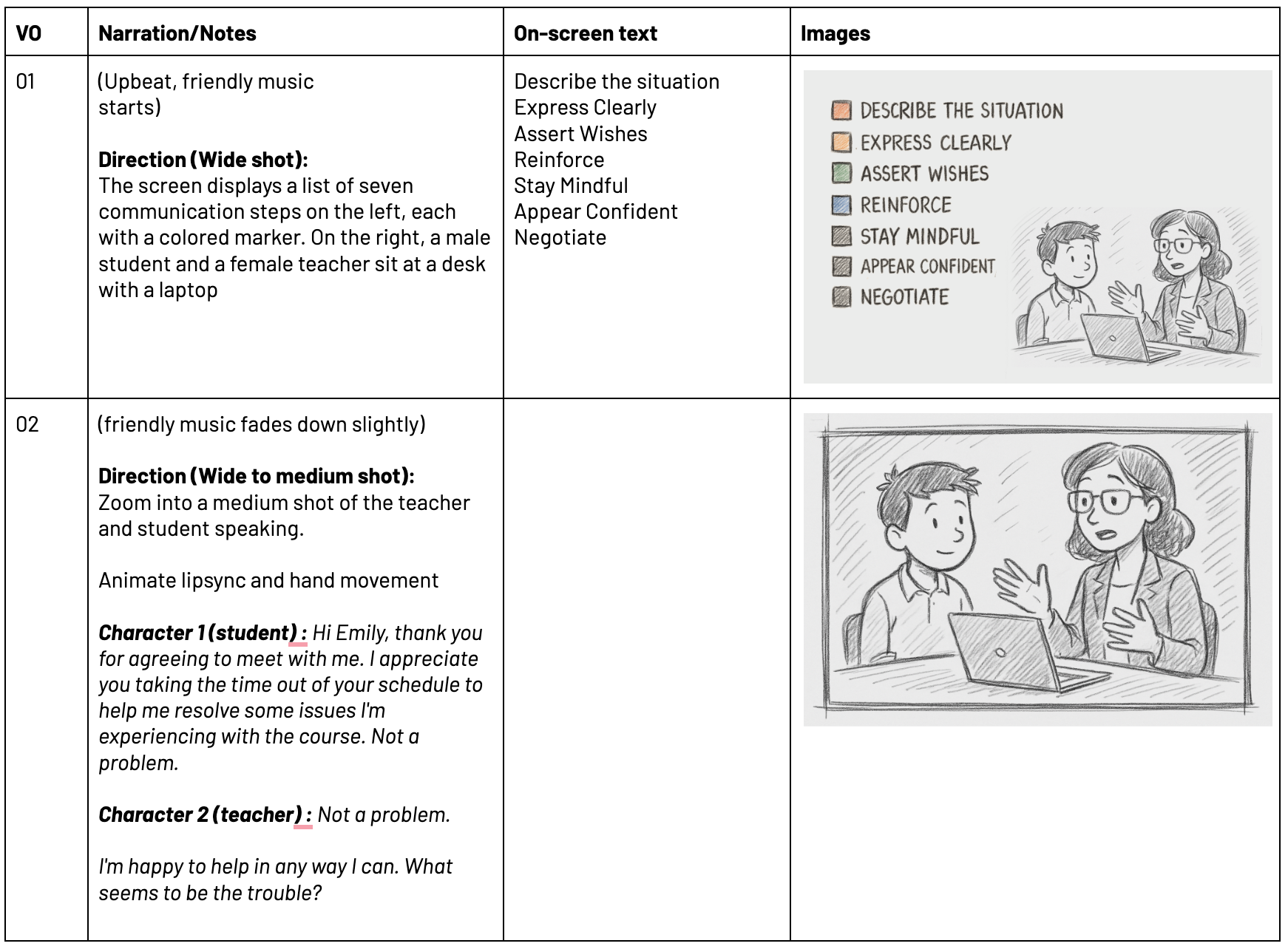
Opening Frame (Scene 01):

  • Purpose: Orient learners to the framework before dialogue begins
  • Visual Strategy: Split-screen showing full DEARSAN acronym on left (color-coded for each step) with characters on right
  • Audio: Upbeat, approachable music to reduce anxiety around "difficult conversation" framing
  • Why This Works: Learners see the roadmap before the scenario, priming them to notice each technique as it appears

Introduction & Describe (Scenes 02-04):

  • Student opens with gratitude and respect: "Hi Emily, thank you for agreeing to meet with me..."
  • Zoom technique: Camera moves from wide to medium shot, focusing attention on interpersonal dynamics
  • "DESCRIBE" text reveal: Punctuates the transition to problem description
  • Factual problem statement: Student lists specific issues (vague questions, unanswered emails, instructor unavailability) without accusatory language
  • Instructor validation: "I take your points" shows receptiveness to professional communication

Visual Teaching Strategy: Each DEARSAN component appears as on-screen text at the moment the character demonstrates it, creating immediate connection between framework and behavior. This dual-channel learning (visual text + character dialogue) reinforces the "what" and "how" simultaneously.
Animation Approach: Humanizing Professional Communication

Character Animation Choices:

  • Lip sync and hand gestures: Creating realistic, natural movement makes the scenario feel authentic rather than scripted
  • Body language consistency: Student maintains respectful posture while showing appropriate concern; instructor displays open, receptive positioning
  • Facial expressions: Subtle emotional cues (student's slight nervousness, instructor's thoughtful consideration) add humanity without melodrama

Pacing Strategy:

  • Conversation unfolds at natural speaking pace (not rushed)
  • Camera movements (pan up to reveal text, zoom in/out) create visual rhythm and guide attention
  • Music fades down during dialogue to prioritize comprehension while maintaining emotional tone

Storytelling for Behavior Modeling

Authentic Scenario Design

The scenario reflects real student frustrations (instructor communication gaps, test fairness concerns, environmental disruptions like construction noise) to establish immediate relevance. By giving the student legitimate grievances, the animation validates student experiences while demonstrating professional response strategies.

Solution Arc:

  • Problem → Process → Resolution structure shows that the framework works—the student gets a positive outcome (retake offer extended to all students) through professional advocacy
  • Teacher's receptiveness demonstrates that respectful communication is more likely to be heard than confrontational approaches
  • Fairness consideration (retake offered to all students, not just the complainer) models ethical thinking and consideration of peer equity

Visual Information Architecture

Color-Coded Framework:

Each DEARSAN step uses a distinct color marker in the opening frame, creating visual categorization that helps with:

  • Memory encoding: Color + acronym + behavior creates multiple retrieval pathways
  • Progress tracking: As the animation advances through steps, learners see where they are in the framework
  • Pattern recognition: Students can mentally map their own situations to specific framework components

Text Timing & Placement:

  • "DESCRIBE" title card: Large, centered text creates a chapter marker, signaling framework component shift
  • On-screen acronym list: Persistent visual reference allows learners to connect dialogue back to framework terminology
  • Minimal text during dialogue: Avoids cognitive overload; focus remains on character modeling

Accessibility & Inclusive Design Considerations

Multi-Sensory Learning:

  • Visual: Character demonstration, on-screen text, color coding
  • Auditory: Dialogue modeling tone, pacing, word choice
  • Reading: Transcript available
  • Captions: Ensuring deaf/hard-of-hearing accessibility

Cultural Considerations:

  • Neutral character styling: Avoids stereotyping while remaining relatable
  • Professional but approachable language: Student uses formal register without stiffness ("I appreciate you taking the time...")
  • Power balance acknowledgment: Student shows respect for instructor's authority while maintaining self-advocacy

Complete Animation Package

1. Storyboard Document

  • 20+ frame breakdown with VO narration, on-screen text specifications, and visual direction
  • Scene-by-scene notes for animator (camera movements, lipsync cues, text timing)
  • Color-coded framework integration throughout

2. Animated Video (2-3 minutes)

  • Character-driven scenario with professional voice acting
  • Full DEARSAN framework demonstration embedded in natural dialogue
  • Music, sound design, and visual effects to support learning without distraction

3. Educational Integration Materials

  • Transcript for accessibility and analysis
  • Suggested discussion questions for classroom use
  • Framework reference sheet linking acronym to demonstrated behaviors

Distribution & Use Cases

Intended Applications:

  • Student Success workshops: Instructor-led sessions on communication skills
  • Online learning modules: Embedded in LMS courses on professional development
  • Peer mentor training: Teaching student leaders to coach peers
  • Counseling resources: Supplementing one-on-one student support
  • Social media snippets: Shareable clips for Instagram/TikTok promoting student services

Learning Outcomes & Educational Value

Immediate Benefits

  • Concrete Modeling: Students see exactly what effective communication looks and sounds like in a high-stakes situation
  • Reduced Anxiety: Seeing a positive resolution demystifies difficult conversations with authority figures
  • Framework Retention: Visual + auditory + narrative integration creates multiple memory pathways for DEARSAN acronym
  • Transferable Skills: Scenario demonstrates principles applicable beyond grade discussions (workplace conflicts, personal relationships, service requests)

Measurable Success Indicators

  • Student self-reported confidence in approaching instructors about academic concerns
  • Workshop engagement metrics (view completion, discussion participation)
  • Anecdotal feedback from instructors about quality of student communication in grade appeals
  • Reduction in informal/unprofessional complaint channels (social media venting, third-party complaints)

Educational Value

This animation transformed an abstract psychological framework (DEARSAN) into an observable, replicable behavior model. By embedding instructional content within a narrative scenario, the project demonstrates that:

  • Soft skills can be taught through storytelling: Character-driven scenarios make abstract concepts tangible
  • Visual learning accelerates comprehension: Students don't just hear about the framework—they see it applied step-by-step
  • Relatability drives engagement: The student's concerns (unanswered emails, test frustration) mirror real experiences, creating emotional investment
  • Positive modeling encourages action: Showing successful outcomes motivates students to try the approach themselves

Project Highlights

  • Behavior Modeling: Demonstrates interpersonal effectiveness through realistic scenario
  • Framework Integration: DEARSAN technique embedded naturally in dialogue
  • Character-Driven Learning: Animation humanizes abstract communication concepts
  • Visual Information Design: Color coding, text reveals, and camera movement guide attention
  • Accessibility Focused: Multi-sensory learning approach with transcript support
  • Transferable Skills: Teaches professional communication applicable across contexts
  • Positive Framing: Shows successful outcome of assertive, respectful advocacy
  • Student-Centered Design: Addresses real anxiety around instructor interactions

Interested in Educational Animation?