Transforming 55% Seat Utilization to 80% Through Strategic eLearning Design
Overview
A cloud-based design collaboration platform was struggling with customer adoption despite strong sales performance. Architecture and interior design firms were purchasing the platform, but 55% of seats remained unused after 30 days—a critical churn risk that threatened revenue retention and growth.
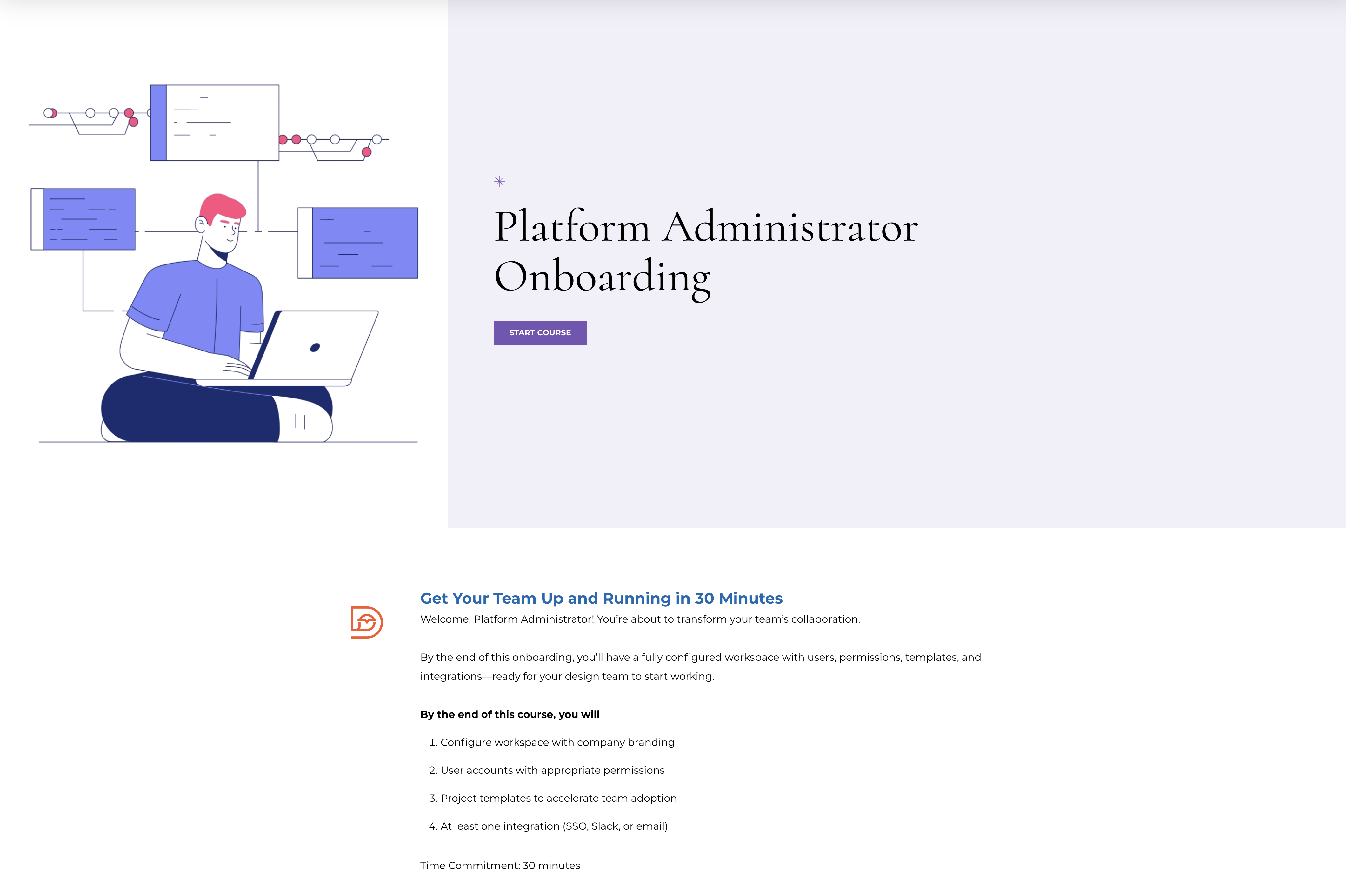
I designed a dual-path customer enablement program that transformed new customers from purchase to daily usage through role-based, self-paced eLearning delivered in Articulate Rise 360. The program included separate learning paths for Platform Administrators (30 minutes) and Designers (15 minutes), designed specifically for each audience's tasks, time constraints, and prior knowledge.
The Challenge
Despite strong sales performance, new customers received login credentials but no structured onboarding. This led to significant challenges:
Using Gilbert's Behavior Engineering Model, I confirmed the gap was primarily a knowledge problem, not motivation or environment. Users had access and motivation, but lacked procedural knowledge of workflows.
My Approach
I applied evidence-based instructional design frameworks throughout the project, including Gilbert's Behavior Engineering Model for performance analysis, Knowles' Andragogy for adult learning principles, Mayer's Cognitive Load Theory for multimedia design, and Wiggins & McTighe's Backward Design for assessment-first planning.
Conducted needs analysis using adult learning theory (Knowles' Andragogy), performed task analysis to identify critical workflows, and developed detailed learner personas for Platform Administrators and End Users. Applied backward design methodology to define terminal objectives and design performance-based assessments before building instruction.
Created two separate learning paths optimized for each audience. Applied Mayer's Multimedia Principles throughout: coherence (eliminated decorative graphics), segmenting (2-3 min chunks), modality (narration + screen recordings), and signaling (callouts, cursor highlighting). Developed detailed narration scripts for 6 videos with timecodes and production specifications.
Built courses in Articulate Rise 360 with complete quality assurance: content accuracy (SME review), navigation flow, WCAG AA accessibility compliance (captions, alt text, keyboard navigation, 4.5:1 color contrast), and cross-device testing. Conducted pilot testing with 5 target users and iterated based on feedback.
Designed comprehensive evaluation plan using Kirkpatrick's Four-Level Model to measure reaction (satisfaction surveys), learning (assessment scores), behavior (usage analytics), and results (business impact including churn rate reduction, support ticket volume, time-to-value, and ROI).
The Solution
I designed two role-based learning paths that eliminated cognitive overload by letting learners skip irrelevant content. Each path was optimized for the specific audience's tasks, time constraints, and prior knowledge:
Administrator Path (30 minutes): Designed for IT Managers and Operations Managers, focusing on workspace setup, user management, templates, and integrations. The outcome was a launch-ready workspace configured in under 30 minutes.
End User Path (15 minutes): Designed for Designers and Architects with billable time pressure, focusing on project creation, file uploads, review cycles, and deliverables. The outcome was completing the first project in under 15 minutes.
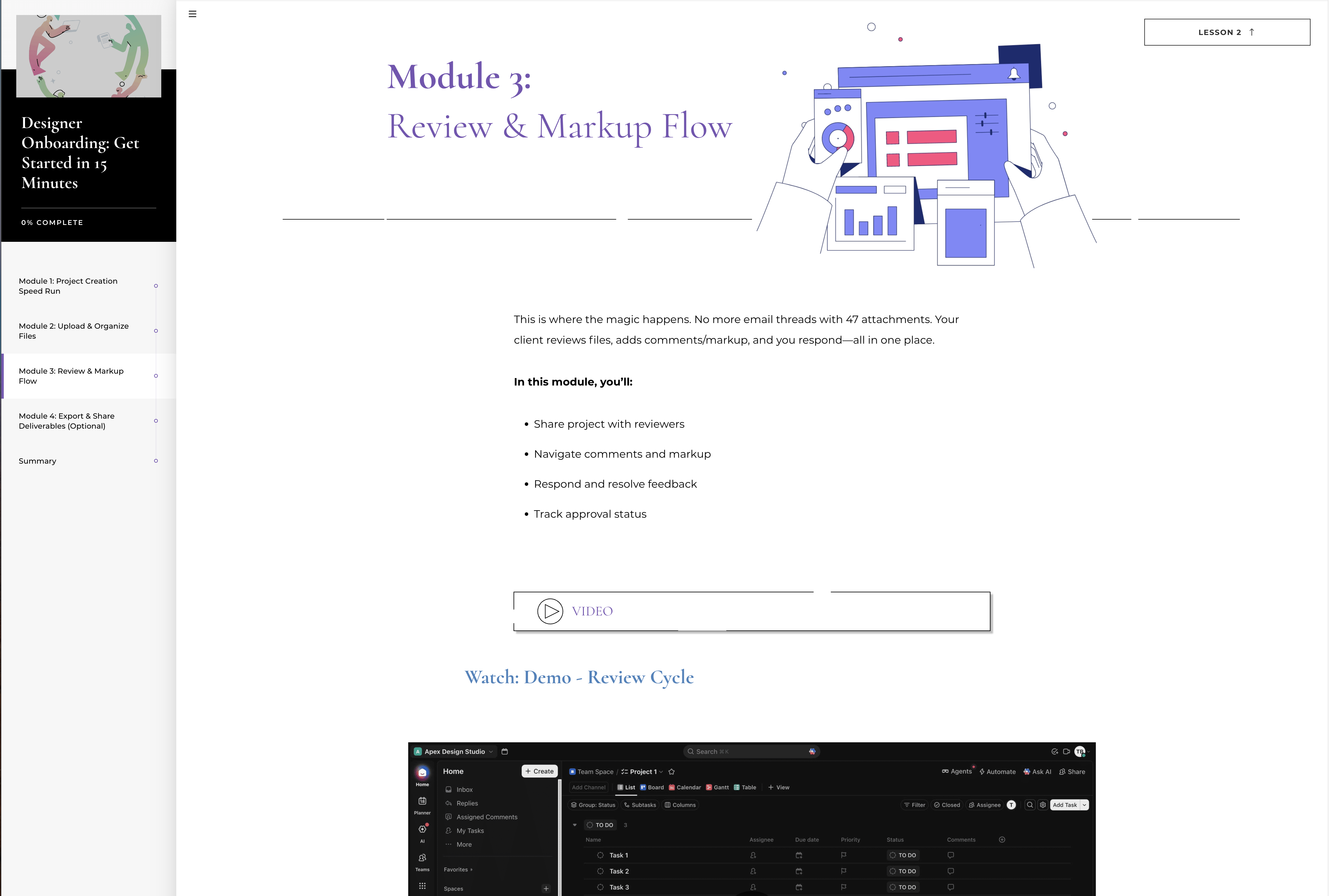
Designer Path: Fast visual instruction for time-constrained professionals
Admin Path: Step-by-step guidance for workspace configuration
Design Decisions
This project showcased several key design decisions that demonstrate evidence-based instructional design expertise:
Rather than creating one comprehensive course covering all features, I designed separate paths for admins and end users. This decision eliminated cognitive overload and increased completion rates by respecting learners' time constraints and prior knowledge. Admins and end users have different tasks, motivations, and time availability—treating them the same would reduce effectiveness.
Applied Knowles' adult learning principles by organizing content around tasks ("Create project," "Complete review cycle") rather than features ("Click this button," "Navigate this menu"). This approach aligned with how professionals actually work and leveraged their existing mental models from similar tools they already used.
Instead of traditional multiple-choice quizzes, I designed authentic performance tasks: "Configure your launch-ready workspace" (Admin) and "Complete your first project cycle" (End User). These assessments measured actual ability to perform job tasks, not just recall of information, and provided immediate business value.
Given the distributed, time-constrained nature of the audience (designers on billable time, admins with competing priorities), self-paced eLearning provided the flexibility needed for completion. This decision also enabled scalable delivery—onboard 1 or 10,000 customers with the same resource investment.
Impact
The dual-path onboarding program delivered measurable business impact across learning, behavior, and revenue metrics:
Reflection
This project reinforced the critical importance of theory-to-practice application. Rather than "making courses," I applied evidence-based frameworks systematically: Gilbert's Behavior Engineering Model for performance analysis, Knowles' Andragogy for adult learning principles, Mayer's Cognitive Load Theory for multimedia design, and Kirkpatrick's Four Levels for comprehensive evaluation.
The audience-centric design approach proved highly effective. By developing detailed learner personas based on research and designing separate paths for admins versus end users, we eliminated irrelevant content and respected time constraints. This decision to treat different audiences differently—rather than forcing everyone through the same training—was key to achieving high completion rates and business impact.
If I were to approach this project again, I would invest even more time in the front-end analysis phase. The detailed learner personas, task analysis, and backward design planning paid dividends throughout development and resulted in a solution that required minimal iteration. The systematic, evidence-based approach not only produced better learning outcomes but also made stakeholder communication easier—I could explain design decisions with pedagogical rationale rather than personal preference.